Robin Good: My personal thanks go to Liz Wilson on the Paper.li Community Blog, where she has published a great article about Adam Westbrook's fantastic eBook "Inside the Story" (I bought a copy after reading her review) where he collects and curate inspirational ideas and anectodes from 24 digital storytellers.
According to the author, the eBook was inspired by a project by Seth Godin – an ebook created collaboratively.
"The key word is authenticity.
Audiences are skeptical of commercials and advertising these days and don’t respond to it.
Journalists are good at telling real authentic stories.
Everyone has a story — even the smallest small business owner — and it is that story which customers respond to now."
The article contains also useful tips, advice and links to resources as well as a short list of brilliant digital storytellers from whom you can take inspiration from.
Thanks for the mention Robin but all credit goes to Adam - a guy who is really trailblazing in online video and entrepreneurial journalism. And doing it alone. He is the inspiration to digital publishers. I recommend everyone to follow his blog www. adamwestbrook.co.uk
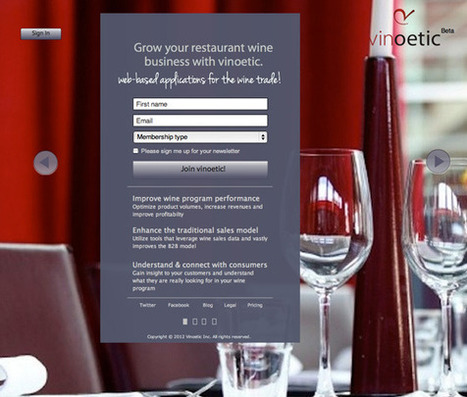
Excerpted from the original article: "In this post Carlos and myself (Oli) are going to analyze one of our customers – Vinoetic.com – landing pages (after they opted to allow us to get our opinionated hands on it).
Our goal is for it to be an educational exercise that can hopefully help improve the page.
Warning for the creator of the page: There are going to be some criticisms, but our goal is for this to be useful to you so that you can have a more successful campaign in the future.
Robin Good: Good article by Meghan Keaney Anderson on the HubSpot Blog. If you are somewhat new to SEO and to optimizing your web site, here's a simple and well illustrated six-step process that can you can follow.
"When it comes to getting your website found in search, little things can make a big difference. But sometimes it's hard to find the time -- or know where to start.
Here's an idea: Set aside 15 minutes in the next week to conduct an audit of what you think are 5 of your most influential web pages.
Then audit those pages with the following six steps to make sure you have all your SEO bases covered."
Here the six steps suggested (get the details on how to carry out each one in the original full article):
Step 1: Check Your Meta Descriptions
Step Two: Review Your Page Title
Step 3: Optimize Your H1 Tags
Step 4: Make Images More User/Search Friendly With Alt Text
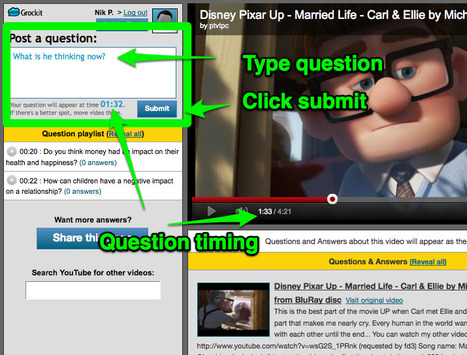
Robin Good: Grockit Answers is a web app that allows anyone to build a Q&A or discussion board around a specific video.
Multiple questions can be asked and each one of them can be connected to a specific point in the video.
Great to introduce new video-based content and engage your fans on it.
"In Grockit Answers, interactions happen around video lectures, and participants ask and answer questions about specific points in the lecture.
Since every question is attached to a specific point in time in the video, Grockit Answers displays a question and its answers at the point in the lecture that they are most relevant.
And since the things that confuse you are likely to be the same things that confuse others, you'll find that answers to your own questions pop up on the screen just as you're starting to get confused."
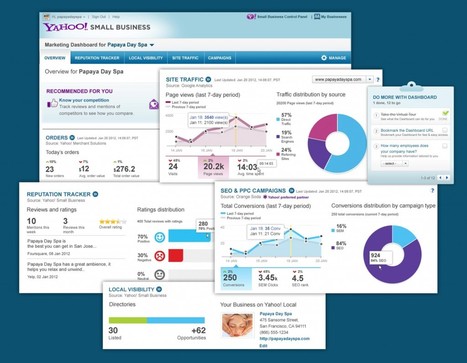
From the official site: "The Yahoo Marketing Dashboard provides a consolidated view of a business’s marketing results and reputation.
Key features include:
1) Business listings:
Find out how many search engines and directories include your business and discover new listing opportunities you may be missing.
2) Online business reputation:
Learn what customers are saying about you across the Web, so you can be responsive to their needs and provide better customer service.
3) Web site traffic:
Discover how many people are visiting your site and where they are coming from by viewing Yahoo! Web Hosting, Yahoo! Merchant Solutions, or Google Analytics site traffic reports.
4) Marketing campaigns:
Track key metrics from email marketing, search engine optimization (SEO), and pay-per-click (PPC) campaigns, so you know what is working.
5) Online sales:
Know how your daily sales are doing with order and revenue reporting from your Yahoo! Merchant Solutions online store.
6) Marketing ideas - Learn about new marketing approaches and leading marketing service providers who can help your business grow."
P.S.: The Marketing Dashboard is specifically designed for small business owners, not marketing experts.
The service is free and is targeted ONLY at US-based businesses.
From the original article: "If you run a website, you know how important search engine rankings can be. Getting your site on the first page of Google can bring in advertising dollars, an influx of new customers, or widespread awareness of your cause.
However, there is much more to ranking high on Google than just optimizing your website for certain keywords. Social media can help (or hurt!) your placement – and the folks at TastyPlacement have done a little testing to see how much Google+, Facebook and Twitter really do affect search results."
Robin Good: Coming Soon Pro is a WordPress plugin that allows you to create a custom landing page, capable of capturing emails of interested parties and of incentivating social sharing.
Excellent for whoever has little time, talent, and money to spend, but is looking to get a professional-looking "coming soon" page.
From the official site: "Easily create a custom Coming Soon Page in minutes that will help your Website Launch become a Success."
Key features:
-> The Coming Soon Pro plugin works with any WordPress Theme.
-> The plugin is visible only to non logged in user.
This allows you to work on your site while visitors see your coming soon page. Also included is a maintenance mode which allows you to gracefully take your site offline after launch.
-> The Coming Soon plugin allows you to capture email leads while you build your site. Tight integration with MailChimp, Constant Contact, Aweber, Campaign Monitor & Gravity Forms.
If you're looking to make money from your blog, here are three ways to use old content to monetize your blog and create regular passive income.
From having advertisements on your blog to selling affiliate links (or your own product), it’s clear that bloggers want to be able to make money from blogging – it’s just a matter of how (and without upsetting your readers).
Look back at your content, and see if there’s an ongoing theme that can be fine-tuned and made available as a premium publication.
2. Create an Educational Video Download
Check your analytics, and see which posts had the most traction. That suggests that there’s an audience for that content, and while your written word may have been popular, a video overview will be even more so.
3. Host a Premium Webinar
If the written word becomes valuable, you can imagine how valuable a live webinar, with the ability to ask questions on the fly and see something happen in real-time, can be.
Ulimately, If You Can Create It, You Can Sell It
Quality never has a price limit on it.
Find the content you feel offers the most value and opportunity to turn into a premium offering.
The good news is, the audience is waiting – you just need to provide."
Giuseppe Mauriello: This is an article by Neil Patel, the co-founder of KISSmetrics, published on the SEOmoz Blog. It talsk about semantic keyword research to help you focus your content and and improve your search engine rankings.
Here is some key points that I excerpted from the article intro:
"From Google’s Panda, Search Plus Your World and Venice updates, in the last year alone the SEO landscape has changed. And while that means your SEO strategy will change, too, there is one thing that remains the same…keywords.
Keywords remain important to your content and link strategies.
But there is one change coming down the Google pipeline that will change keywords…semantic search technology and the human element.
Semantic search is technology that tries to determine what users mean when they type in a certain keyword.
In your SEO campaigns semantic search means you will have to identify the right keywords based upon user intent in the real world…and then create content around those terms.
Having a database of semantic keywords to create high-converting blog posts is one advantage…but there are other benefits:
- Higher click-through rate...
- Lower minimum bids...
- Higher quality score...
Employing a semantic keyword plan is crucial.
But how do you come up with those keywords?
Here are five approaches to use…including recommended tools.
1) Using Google advanced search...
2) Semantic keyword research with bookmarking tags...
3) Building a semantic keyword cloud through social monitoring tools...
4) Optimizing semantic keywords around trends...
5) Gathering semantic keywords through social search...
Keep in mind that as much as semantic keyword research is about finding actual keywords you can use in your SEO campaigns…it’s just as much about building a complete profile of your target customer. And the better you can understand your target customer the better your campaign results will be!..."
Each element is analyzed with more information, examples and many tools.
Robin Good: If you are still thinking about marketing as the most efficient and direct way to make your customers buy from you, it is time to start reconsidering this approach.
Going for the sell, sell, sell approach has worked for decades and for millions of sales people, but now, the most effective and durable way to make your business thrive, is once again the one that requires no thinking: don't think about selling, think about helping and listen closely to what your potential customers want.
That's all there is to it: make yourself accessible and truly helpful.
To exemplify what it takes, the short story of Eydie Stumpf may help you out: "When I first moved to California in 1998, I worked as a car and truck sales person.
Never having sold anything in my life, this was a completely new world for me.
The goal, as was explained to me, was to put every person who walked onto the lot into a vehicle — period.
The sales manager trained me and provided me with various scripts that I was to use to overcome objections.
Every morning we began the day with a sales meeting and afterwards, the sales team marched into the trenches with the words sell, sell, sell, throbbing in our heads.
After about a week on the job, a team member approached me. He bluntly told me that I would never make it as a car sales person.
“You’re too nice”, he said.
“You can’t make friends with the customers. They’ll never buy from you.”
Morale of the story:
"Relationship marketing is not just for social media.
Build relationships using your blog, email marketing, and offline events like networking groups, business expos, mixers, and speaking opportunities.
Online or off, attract loyal customers by allowing them to know who you are, know who they are, and enlighten them with the priceless information you have that can solve their problem."
From the article: "I find Twitter the most essential social media tool for Internet Marketers on many levels, mainly because of its search API.
Unlike Facebook's and Google Plus's non-existent search options, Twitter makes it easy to go through the huge amounts of updates being published every minute and find those which are relevant (and important) to your brand.
Twitter search is priceless for various tasks:
- Track updates from any niche conference or event (through the official hashtag). In this particular case, archiving is very essential because your archive will let you find testimonials for your next event or quotes for your event coverage, etc.
- Monitor most recent link building opportunities. I for one use Twitter search to instantly react to niche guest posting invites;
- Monitor your own brand mentions (both linked and unlinked). Here's one post I did previously on awesome Twitter search operators that let you filter out all the clutter and track only very essential brand mentions (for example, filter out Twitter updates that contain links and only listen to "real" conversations);
- Keep an eye on your competitors and how they are doing on Twitter (for example, find negative mentions and be there to offer a better alternative)
- Identify active users and influencers within your niche (and get connected to them).
The free Google Spreadsheet I am reviewing in this article can help you with all the above tasks: it collects tweets, archives them and lets you analyze them! [..]"
Robin, terrific article. I've been using rowfeeder for this task (not free) and use it to capture tweets after I do presentations (http://www.bethkanter.org/data-viz-12ntc/) - now wondering what rowfeeder offers over the method mentioned in the post?
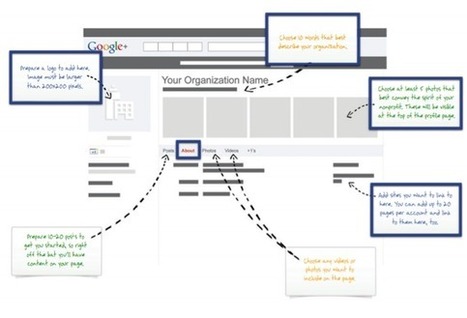
A tactical guide for Google Plus covering page creation, daily management, and key optimizations with other Google products... You can start right now with your Google+ [note mg]
Taking full advantage of the SEO and PPC benefits associated with a strong Google Plus presence requires creating a complete Google Plus Brand Page. The following post serves as a tactical guide for Google Plus covering page creation, daily management, and key optimizations with other Google products.
For more detail on the SEO benefits of Google+ for individual user accounts, check out AJ Kohn’s amazing and comprehensive post.
Robin Good: Andrew Edwards at Clickz provides some interesting and valuable advice for content producers that I strongly recommend you pay attention to.
He writes: "Look at any tabloid today (but hurry, as they are mostly going the way of all tree-based media) and you'll notice the following traits:
1) catchy, sometimes kitschy headlines;
2) active voice (subject, verb, few adjectives, no adverbs);
3) short paragraphs without semicolons (!); one sentence = one idea; and, if referencing culture, make it pop culture.
This last one is important because we're now in an era where one apologizes for erudition lest it may embarrass a certain type of reader or - night terrors! - send someone to the "dictionary."
Include images, as they speak at least a couple of hundred words these days.
...
Finally, make sure your text is broken up (by subheads if possible, but not more than a few per thousand words). It creates white space."
That's gold advice, written in three paragraphs.
"...If you don't care about whether anyone ever pays you for your work, go ahead and do anything you want. You may get lucky.
But if you're expecting to get paid, follow the guidelines.
Do the work and do it well. And care about what the audience wants.
If you care enough and are good enough, your audience most of the time will reward you."
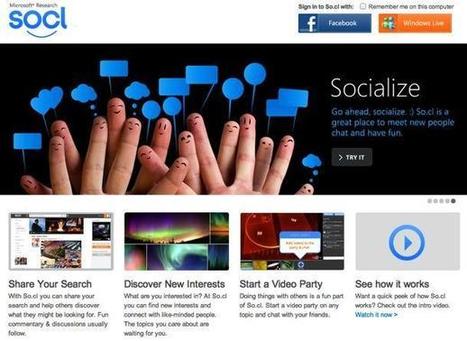
"Over the weekend, Microsoft quietly launched an experimental social network called So.cl. which combines facets of social networking, search, and media sharing with a user interface resembling Google+.
Users are encouraged to search for information about a particular topic, then compile the best results - textual content, images and videos - into a single post.
So.cl is initially targeted to students. It may end up being useful to that market, but it's unlikely to get traction as a mainstream social network."
francesco guglielmin's comment May 22, 2012 12:39 PM
Seems very good as interface , for now anyone can request invite that arrive after a little time. Sincerely i don't know how many users it will attract
Google has just introduced the "Knowledge Graph" — or semantic analysis — to its most fundamental tool, search. Here's what that means.
From the original article on Mashable: "Starting today, a vast portion of Google Search results will work with you to intuit what you really meant by that search entry.
Type in an ambiguous query like “Kings” (which could mean royalty, a sports team or a now-cancelled TV show), and a new window will appear on the right side of your result literally asking you which entity you meant.
Click on one of those options and your results will be filtered for that search entity.
To understand the gravity of this change, you need to know about the fundamental changes going on behind the scenes at Google Search.
...Google is switching from simple keyword recognition to the identification of entities, nodes and relationships.
In this world, “New York” is not simply the combination of two keywords that can be recognized. It’s understood by Google as a state in the U.S. surrounded by other states, the Atlantic Ocean and with a whole bunch of other, relevant attributes.
As Ben Gomes, Google Fellow, put it, Google is essentially switching “from strings to things."
"In addition to the window which will help users find the right “thing,” Google will also surface summaries for things, which, again, will try to be somewhat comprehensive by tapping into the various databases of knowledge.
A search for Frank Lloyd Wright, for instance, will return a brief summary, photos of Wright, images of his famous projects and perhaps, most interestingly, related “things.”"
Robin Good: Seth Godin lays out 21 points to make money online. My favorites ten are:
"1) Stop Googling things like, "how to make money online." Not because you shouldn't want to make money online, but because the stuff you're going to find by doing that is going to help you lose money online. Sort of like asking a casino owner how to make money in Vegas...
2) Don't pay anyone for simple and proven instructions on how to achieve this goal. In particular, don't pay anyone to teach you how to write or sell manuals or ebooks about how to make money online.
3) Get rich slow.
4) Focus on the scarce resource online: attention. If you try to invent a way to take cheap attention and turn it into cash, you will fail. The attention you want isn't cheap, it's difficult to get via SEO and it rarely scales. Instead, figure out how to earn expensive attention.
5) Focus on trust. Trust is even more scarce than attention.
6) Don't worry so much about the 'online' part. Instead, figure out how to create value. The online part will take care of itself.
7) Build a public reputation. A good one, and be sure that you deserve it, and that it will hold up to scrutiny.
8) Obsessively specialize. No niche is too small if it's yours.
9) Hang out with people who aren't looking for shortcuts. Learn from them."
10) Read the rest of Seth's recommendations. It's worth it.
As a business owner, it may be hard to delegate time for yourself or your employees to write quality content for your blog vs. work on revenue generating projects.
And when it comes to content, we’re not talking about just any content, but content that people want to read, search engines want to crawl, and social media users want to share.
Finding Guest Bloggers
One of the first things to increase the content on your blog, is including guest bloggers to help you out. Guest bloggers get a lot of benefits by writing for other sites, including yours, such as exposure to a new audience, the chance to build their authority, and the ability to build quality links back to their own blog or website.
How to Create Guest Blogging Guidelines
The easiest way to attract guest bloggers to your blog is through the creation of a guest blogging guidelines page.
"Warning: If you're addicted to spending ungodly amounts of money in an effort to interrupt enough people into becoming "aware" of your product, service, or idea ... skip this. You ain't gonna like it."
Robin Good: A great article by Robert Bruce on CopyBlogger starts with this very warning and deservedly so.
The article talks about the myth of creativity in selling and of how much inappropriate is the traditional advertising business model with the new situation we are in right now in .
In the traditional world, here's whata typical advertisign agency may say:
"We pride ourselves on creativity, not playing it safe, doing things that no one has ever seen before."
Huh? Speaking to an audience, and selling to them, is largely an exercise in having the wisdom to enter a conversation that’s already happening in the prospect’s mind. It’s using the language the audience is already using.
Creating things that “nobody has seen before” — aside from the hyperbole of that statement — could work well as ride in an amusement park, or a fireworks display, but it’s the kiss of death in the art of selling."
And here's more juice on what you REALLY need to do:
"Three steps to a successful approach
The equation used to be: money x media = business.
The new equation is: time x media = business.
In other words, every company is a media company.
...
Here are three steps to creating a “campaign” that will last:
1) Build a minimum viable audience with useful, educational, and entertaining content.
2) Listen carefully to their frustrations, fears, problems, and desires.
3) Create or adapt products and services that better serve them."
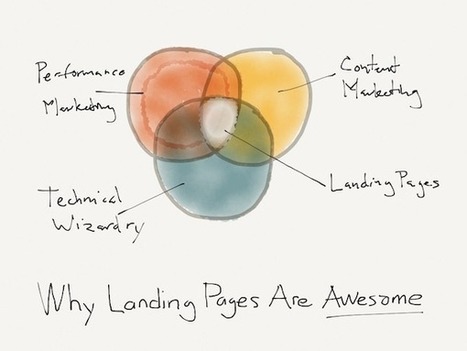
Excerpted from the original article: "Landing pages are the heart and soul of an inbound marketer's lead generation efforts, so why are they still so underutilized?
The number one reason businesses don't use landing pages is because their marketing department doesn't know how to set them up or they are too overloaded.
First, let's start with a simple definition:
A landing page is a web page that allows you to capture a visitor's information through a lead-capture form (AKA a conversion form).
Creating landing pages allows you to target your audience, offer them something of value, and convert a higher percentage of your visitors into leads, while also capturing information about who they are and what they've converted on.
Landing pages can make your marketing and lead generation efforts more effective.
Here are 6 more compelling reasons:
1) Easily Generate Leads!
If you could do one thing right now to drastically improve your lead generation efforts, it would be to use landing pages on your website.
2) Give Your Offers a Place to Live:
The idea is to require your website visitors to 'pay' you in contact information for something valuable like an offer, and your landing page is the collections tool.
3) Collect Demographic Information About Your Prospects:
Every time a lead completes a conversion form on a landing page, your marketing and sales team is collecting valuable information about your leads.
4) Understand Which Prospects Are More Engaged: Landing pages not only enable you to generate new leads; they also allow you to track reconversions of existing leads, which you can then use to identify which prospects are more engaged with your business.
5) Provide Fuel for Other Marketing Channels:
Landing pages are a great addition to any marketer's content arsenal since they can be shared in social media, used as the focus of dedicated email sends and in lead nurturing campaigns, be linked to in PPC ads, and get found in organic search.
6) Offer Insights Into the Effectiveness of Your Marketing Offers: Every time you create a landing page, you're creating another data asset for your marketing program.
Landing pages should always be followed up by what's called a 'thank-you page,' that confirms receipt of the lead's information and either provides the offer, or details the next steps for receiving the offer..."
Robin Good: Do you know how to calculate how much a new customer is worth to your online business?
Knowing that value can help you make better strategic decision about how much to invest in advertising, marketing and customer service activities to retian the good customers you already have.
But you need to know first how much they are really worth to you.
From the original article: "It’s strange, but many small-business people have no idea what a good regular customer is worth to their business.
By calculating that figure, you should gain a better idea of what you’re willing to invest or risk to attract a good, regular customer.
The calculation will also tell you how important it is to keep your existing customers happy.
The cost of retaining a customer and even expanding a customer’s value is much less then getting a new customer.
To determine what you’re willing to invest in marketing, first discover what an average new customer is worth to you.
To determine their value, answer the following questions:
1. What is your average sale (transaction amount)?
2. What is the frequency of your average customer?"
It just got a whole lot easier to reach your most engaged customers with video... Announcing Google AdWords for video.
Robin Good: Video Ads created with Google AdWords for Video can appear on YouTube, the world's largest video community as well as on sites on the Google Display Network -- "the world's #1 ad network, reaching 89% of online users".
Best of all, you pay only when viewers choose to watch your video ad.
From the review on SEJ: "Google today took their Adwords for Video program out of beta and announced their “official” launch, integrating their paid search advertising model with video content, whole new ad formats, and bidding models.
While I certainly commend Google for their goal of making video advertising available, affordable, and measurable for everybody, there are two things I believe should have done differently to get more businesses involved with the new video ad program."
Robin Good: If you are looking to become a respected and trusted authority in your niche, here is something important to pay attention to.
Competence and expertise is not the only critical factor.
To trust and support you, your fans must know what you are really after, and unless you make some very conscious efforts to do so, it may be likely that most people are not clear, or outright confused about your true mission.
Linda Hill and Kent Lineback spell very well out the logic behind this while providing you with three key steps you can take now to overcome this issue.
Excerpted from their article intro on HBR: "...our feelings about someone, whether we fear or trust them, are largely determined by their intentions.
By divining what they want, we answer the question we all instinctively ask about someone new: ally or enemy?
Intentions are how we distinguish a villain from someone whose influence we accept, whom we move toward. Competence may be appealing, but intentions are what attract or repel us and foster trust or mistrust.
Thus, if you want to lead and influence others, you must reveal your intentions.
People won't believe you will do the right thing unless they're convinced you genuinely want to do it.
That requires more conscious effort than most bosses understand.
We all more or less assume that others will see our positive motives or at least give us the benefit of the doubt.
But it often doesn't work that way.
As a leader and manager, you must often make tradeoffs among the competing interests of your own group, other groups, the organization as a whole, important outsiders, and the individuals who work for you. That obviously creates many opportunities for people to misinterpret your intentions.
That's why it's often critical to take conscious and purposeful steps to reveal your motives and values and to open yourself so others can see inside you.
Here are three important ways to reveal your intentions and convince others of their sincerity."
Robin Good: Facebook Offers is a new service from Facebook which allows Page owners to publish unique offers and discounts to their readers.
Facebook Offers makes it in fact possible for anyone who “likes” a business or brand on Facebook to receive special deals.
How it works
1) A Business Page can post Offers to their page just like they would any status update and the Offer will appear in the follower’s news feed.
2) Offers images are 90 pixels by 90 pixels. Headline text allows 90 characters. Terms and conditions text allows 900 characters.
3) You have to set an expiry date.
4) You can see how many people have claimed your Offer below the offer’s headline and you can choose to target your Offer’s audience by country and language.
5) To Claim Offers when people see your Offer in their news feeds or on your Page, they’ll need to follow these steps to claim and redeem your Offer:
Click Get Offer to see details. Then they Click Claim Offer to have the offer sent to their email address associated with their Facebook account.
From the article intro: "Word-of-mouth recommendations and reviews, either from someone they know or a stranger’s opinions online, are the most trusted sources of information for buying decisions, according to the latest Nielsen’s latest Global Trust in Advertising report.
The findings speak highly for information gathered through social media or other forms of user-generated content."
Check this for example: "...though traditional paid media still are trusted by a great number of consumers, their influence is on the decline.
Nearly half of consumers around the world say the trust ads on TV (47%), in magazines (47%) and in newspapers (46%), but those numbers dropped by 24%, 20% and 25% respectively, in a relatively short period of time — between 2009 and 2011."
Enhance your Facebook Pages with these timeline ready apps. A total of 25 facebook apps to choose from, including BONUS app suggestions to improve fans engagement.
For page managers who know how to work with Facebook apps, the new Timeline layout for Pages is a great opportunity to highlight their application tab for maximum visibility and increase click through rates.
But for those who aren’t, finding those timeline ready apps can be a massive headache.
To get content containing either thought or leadership enter:
To get content containing both thought and leadership enter:
To get content containing the expression thought leadership enter:
You can enter several keywords and you can refine them whenever you want. Our suggestion engine uses more signals but entering a few keywords here will rapidly give you great content to curate.


 Your new post is loading...




![How Much Social Signals Affect Your Google Rankings and Visibility? [Infographic] | Internet Marketing Strategy 2.0 | Scoop.it](https://img.scoop.it/iJehm89crMnRIZnwhpSRyTl72eJkfbmt4t8yenImKBVvK0kTmF0xjctABnaLJIm9)